
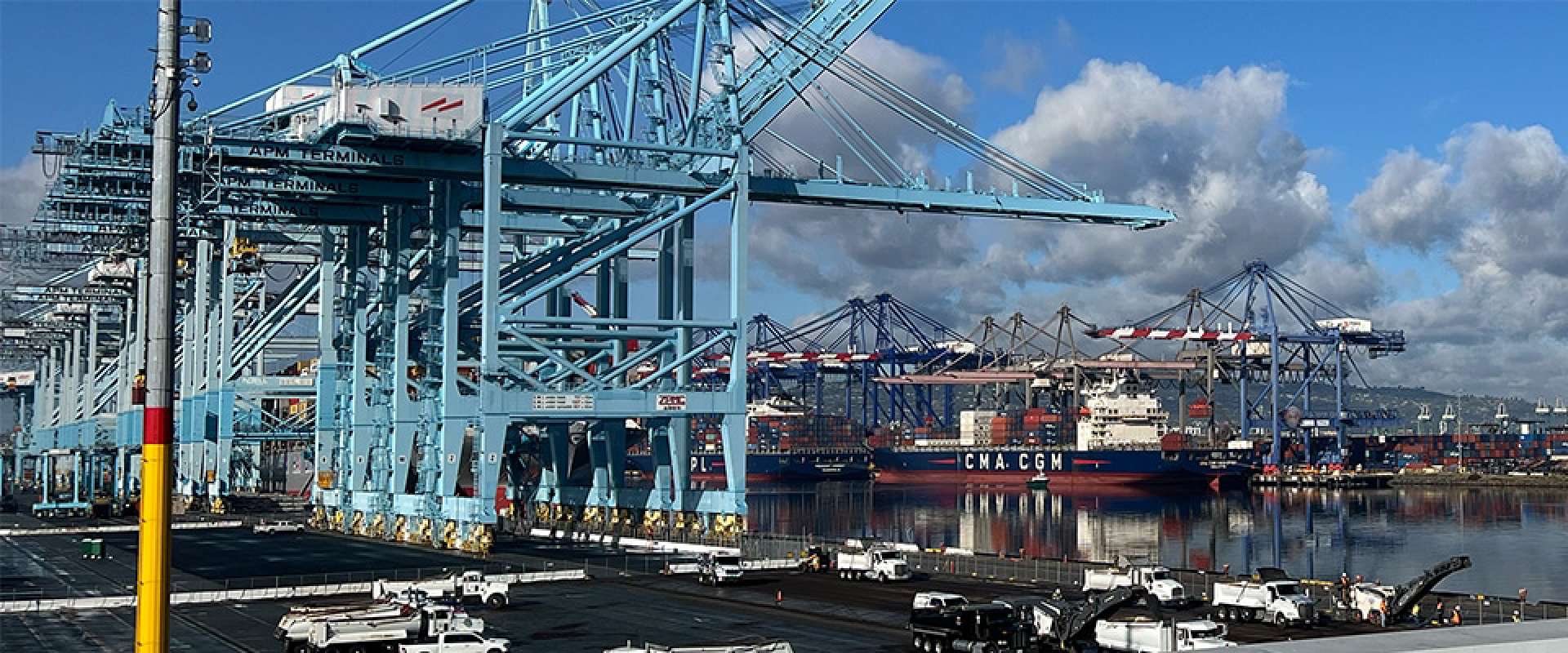
A seaport never really wakes up. That’s because it never fully sleeps. At any given hour, massive container ships ease toward the docks while others pull away, guided by pilots, tugboats, and dock crews moving with practiced precision. Cranes swing overhead, lowering steel boxes the size of small homes onto waiting trucks. Forklifts take shortcuts among piles of cargo. Shipments are held in U.S. Customs while teams rearrange schedules on the fly. Everything moves, everything is noisy, and there is little room to make mistakes. A single misplaced order or a late message can spread across an entire terminal.
Communication is quietly keeping everything moving amid the managed chaos. Not flashy. Not loud. Just constant. Such is where the two-way radios come in handy time and again. Push-to-talk communication is a savior in a world where cell service may not always be reliable and seconds count.
This blog explores which two-way radios are most commonly used in seaport operations, why they are so critical to day-to-day port activity, and what features truly matter when choosing radios for dockside and terminal use. Before diving into specific equipment, it helps to understand why radios play such a central role in keeping seaport operations moving safely and efficiently.
Why Two-Way Radios Are Essential in Seaport Operations
Seaports cover enormous physical footprints. Terminals stretch for miles, with vessels offshore, loading crews dockside, warehouses further inland, and security teams monitoring everything in between. Trying to manage that level of activity without instant communication would be nearly impossible.
Two-way radios provide port teams with a shared voice over that distance. With a single button press, instructions move faster than text messages ever could, and far more reliably than phone calls in a noisy, signal-challenged environment. Whether coordinating vessel movements, responding to security concerns, or adjusting loading priorities, two-way radios keep everyone aligned in real time.
Another problem seaports experience constantly is noise. Engines roar. Containers slam into place. Communications compete with wind, water, and machinery. Cell phones do not work here. However, specially designed two-way radios are designed to suppress background noise and bring speech to the foreground. Such clarity minimizes errors, callbacks, and risky misunderstandings.
Security also burdens port operations. Security staff need to remain on high alert for international cargo, restricted zones, and high-value goods. Security teams must have immediate access to one another when something is amiss. Radios enable immediate alerts, group communication, and, with location awareness, help teams respond more safely, efficiently, and swiftly.
In addition to safety and security, radios simply make the day-to-day seaport work easier. Dock crews continually change work schedules, move heavy equipment, and react to shifting vessel arrivals. Two-way radios enable seaport operations to be adjusted, keep crews informed, and dramatically reduce downtime. Reliable communication keeps operations running at maximum efficiency.
And that brings us to a key issue: what exactly makes a two-way radio particularly suitable for this harsh environment?
What to Look for in a Two-Way Radio for Port Operations
Durability
First, durability is non-negotiable. Salt air corrodes. Water finds its way into everything. Radios used as walkie-talkie dockside devices must withstand rain, spray, dust, and occasional drops onto concrete or steel (MIL-STD-810H). High ingress protection ratings (IP55-68) are essential, along with reinforced housings designed for industrial use.
Intrinsically Safe
Another key factor is safety. Some seaport environments may involve flammable substances, fuel storage, or isolation within a hazardous containment facility. Such environments require intrinsically safe radios that would reduce the risk of ignition.
Quality Audio
Audio also differentiates consumer equipment from professional equipment. The walkie-talkie seaport environment requires clear, high-quality audio that is easily understandable, with no background distortion from engines and machinery. High-end noise-reducing microphones and speakers are necessities.
Coverage Area
Adequate two-Way radio coverage is also essential. Warehouses, metal structures, and thick concrete are among the obstacles that may block weaker signals. UHF radios are typically used at the dockside because they perform optimally around obstacles, whereas marine VHF radios are used on vessels at sea. Adequate power and robust system engineering ensure messages do not drop.
Safety Features
Contemporary seaport radios also have built-in safety features. GPS tracking helps supervisors quickly locate staff. Emergency alerts and lone-worker surveillance are additional safety measures, particularly when the employee is on an overnight or isolated shift.
Independent Networks
Finally, independence from public networks is a significant advantage. Two-way radio port operations don’t rely on cellular infrastructure that can become overloaded or fail during emergencies. Two-way radios work when everything else doesn’t.
Together, these characteristics define a seaport-ready radio. With that foundation in mind, let’s look at some of the most commonly used radios in seaport operations today.
Commonly Used Two-Way Radios in Seaport Operations
Motorola MOTOTRBO™ R7 Digital Portable Radio
The Motorola MOTOTRBO R7 is built for environments where clarity and toughness are equally important. It delivers exceptionally loud, clean audio, even in environments with heavy machinery and constant motion. Its advanced noise suppression actively filters out background interference, making conversations easier to understand without repeated transmissions.
With an IP68 rating, the R7 is fully sealed against dust and able to withstand water immersion; an essential advantage in wet, salty dockside conditions. Its long battery life supports extended shifts without frequent swaps.
Best for: Port security teams, terminal supervisors, crane operators
Key strengths: Intelligent noise cancellation, extended battery performance, industrial-grade durability
Motorola MOTOTRBO™ R2 Portable Two-Way Radio
The Motorola MOTOTRBO R2 is a dependable workhorse designed for large teams that need consistent communication without unnecessary complexity. Lightweight but rugged, it handles daily wear while remaining comfortable for all-day use.
Its strong audio output ensures messages come through clearly, even on busy docks. The R2 offers excellent value for ports that need to equip large crews with reliable radios without sacrificing performance.
Best for: Dock crews, maintenance teams, general port staff
Key strengths: High audio volume, water and dust resistance, ergonomic design
Motorola MOTOTRBO™ XPR 5000e Series Mobile Radios
For fixed or vehicle-mounted applications, the Motorola MOTOTRBO XPR 5000e Series delivers powerful performance across sprawling port operations. These mobile radios are commonly installed in trucks, cranes, and control vehicles where dependable communication is essential.
Designed to handle harsh maritime environments, the XPR 5000e Series supports robust audio, extended coverage, and advanced safety features that enhance coordination across moving assets.
Best for: Port vehicles, cranes, operations centers
Key strengths: High output power, rugged construction, advanced connectivity options
Together, these radios form the backbone of many modern two-way radio seaport communication systems, supporting everything from daily logistics to emergency response.
Equipment Is Only Part of the Equation
Even the best radios won’t deliver results if they aren’t properly selected, programmed, and supported. Port environments are complex, and communication systems must be engineered to reflect how teams actually work.
That’s where professional guidance matters. System design, coverage analysis, installation, and ongoing service ensure radios perform reliably across the entire facility. Without that support, expensive equipment can fall short of expectations.
This is where SJM Industrial Radio plays a critical role, helping port operators choose the right solutions, program and install them correctly, and keep them running when it counts.
Trust SJM Industrial Radio for Your Seaport Communications Needs
Streamline your seaport and shipping terminal operations with reliable Motorola Solutions two-way radio communication systems from SJM Industrial Radio. SJM Industrial has been the wireless telecommunications leader in the Los Angeles area for over 30 years.
From vessel docking and container management to terminal security and logistics, Motorola radios from SJM Industrial Radio keep your teams connected, productive, and safe around the clock. When managing vessel schedules, container movement, and dockside operations, every second counts. Motorola two-way radios from SJM Industrial Radio deliver instant communication across your seaport or terminal.
Contact SJM Industrial today and get started on the right integrated voice, video, and data communications solution for your entire seaport operation.
Contact SJM Industrial TODAY!